
Egypt Upper Nile Travel Guide
Aswan Travel Guide: The Gateway to Nubian Magic
Bask in the golden serenity of Egypt's southernmost frontier. Aswan is a land where the Nile winds through giant granite boulders, emerald islands host botanical treasures, and the warm spirit of Nubia colors every corner of the landscape. From the romantic island temple of Philae to the colossal sun-temples of Abu Simbel, Aswan offers a journey into the soul of the river.
Welcome to Aswan: The Soul of the Nile
Situated at the First Cataract of the Nile, Aswan is widely considered the most beautiful and atmospheric city in Egypt. While Cairo pulses with a frantic energy and Luxor feels like a massive open-air museum, Aswan offers something essentially different: tranquility. This is the Egypt of postcards, where local felucca sailboats with their graceful triangular sails navigate the deep blue waters, and the Sahara Desert’s golden dunes literally spill into the river.
For more than 4,500 years, Aswan served as Egypt’s southern military and commercial frontier. It was the crucial trading hub for ivory, gold, and spices, and most importantly, the source of the granite that built the ancient world. The city’s history is a palimpsest of Pharaonic, Roman, Byzantine, and Islamic influences, all woven together by the enduring presence of the Nubian people. In Aswan, time seems to flow with the same deliberate grace as the river itself—slow, steady, and profound.
Aswan Travel Guide Overview
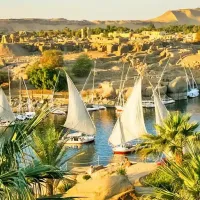
Aswan is the strategic and cultural capital of Egypt's southernmost governorate. Located approximately 890 kilometers (550 miles) south of Cairo, it is the last major city before the border with Sudan. One of the driest inhabited places on Earth, Aswan’s climate is dominated by the desert, yet the city is a lush oasis thanks to the Nile. The river here splits into several channels as it maneuvers around giant, smooth boulders of granite—a natural barrier that created the first of the Nile's spectacular cataracts.
This spectacular geography has shaped the city's identity. The Granite Quarries provided the stone for the obelisks and statues of Luxor and Giza. The Aswan High Dam, completed in 1970, brought modern electricity to millions but also permanently changed the landscape by creating Lake Nasser and forcing the resettlement of entire Nubian communities. Today, Aswan is a city of layers, where 20th-century engineering exists alongside temples that were moved stone by stone in a historic act of international solidarity.
Why Visit Aswan?
Aswan is not just a destination; it is an experience. If you are looking for the "authentic" Egypt, away from the intense crowds, this is the place. Here are the core reasons to visit Aswan:
Natural Beauty
The contrast of deep blue water, green palms, and orange desert dunes creates a natural color palette that is simply stunning.
The Nubian Soul
Nubian culture is the heart of Aswan. Their colorful architecture and music offer a window into a heritage that predates the Pharaohs.
UNESCO Heritage
See the results of the greatest rescue mission in history. Temples like Philae and Abu Simbel were moved stone-by-stone to save them from flooding.
History & Cultural Significance
In antiquity, the city was known as *Swenett*, derived from the name of the Egyptian goddess of birth. Aswan was the southernmost outpost of the Pharaonic empire, located north of the first cataract's rapids. This made it the transshipment point for trade and the primary defense line against southern threats.
The city's greatest gift was its granite. The Aswan granite quarries were the backbone of Egyptian architecture. Using only copper tools and dolerite balls, ancient laborers carved monolithic obelisks weighing over a thousand tons. These massive stones were then floated downstream during the annual Nile flood. The Unfinished Obelisk, still lying in its quarry today, shows the exact moment a flaw in the stone halted a colossal project.
The Living Heritage of Nubia
Beyond the stones, Aswan is the heart of Nubia. The Nubians are a distinct ethnic group with a history reaching back to the dawn of civilization. Known in ancient times as the "Land of the Bow" (*Ta-Seti*), Nubia was a land of warriors and powerful queens. For a time, Nubian kings even ruled all of Egypt as the Pharaohs of the 25th Dynasty.
The construction of the High Dam in the 1960s flooded their ancestral lands, but the Nubian spirit remains vibrant. You can see it in the brightly painted houses of Elephantine Island, hear it in the rhythmic patterns of the *duff* drum, and taste it in the spice-rich cuisine. The Nubian language is still spoken in households across Aswan, preserving an oral history that spans millennia.
Top Attractions in Aswan: Must-See Landmarks
1. Philae Temple (The Sanctuary of Isis)
Dedicated to the goddess Isis, the Temple of Philae is arguably the most romantic temple complex in Egypt. Originally situated on the sacred island of Philae, the temple was submerged for much of the early 20th century following the construction of the Aswan Low Dam. When the High Dam threatened to submerge the temple permanently, UNESCO launched a heroic rescue mission. Between 1977 and 1980, the entire complex—40,000 blocks—was dismantled and reassembled on Agilkia Island. Today, visitors arrive by motorboat to see a masterpiece of Ptolemaic architecture, including the famous Kiosk of Trajan.
2. The Unfinished Obelisk
In the northern granite quarries lies a giant that never stood up. Commissioned by Queen Hatshepsut, the Unfinished Obelisk was intended to be the tallest in the world, weighing an estimated 1,200 tons. However, as the workers were carving it out of the bedrock, a crack appeared, and the project was abandoned. It gives modern archaeologists an "open textbook" on how obelisks were made, showing the marks of the dolerite hammers and wooden wedges.
3. Abu Simbel Temples
While 280 kilometers south of Aswan, Abu Simbel is an essential day trip. Carved into the cliffs by Ramesses II, the two temples are a monumental display of power. Four 20-meter tall statues of Ramesses II guard the entrance to the Great Temple. Abu Simbel was also successfully relocated in 1968. The precision was so great that the temple's famous solar alignment—where the sun shines into the sanctuary to illuminate the gods twice a year—was preserved.
4. Elephantine Island: History and Nubian Life
Elephantine Island is the biggest island in the Nile at Aswan. It was believed to be the home of the ram-headed god Khnum. Today, it is a fascinating blend of ancient ruins—including an ancient Nilometer used to measure floods—and vibrant Nubian life. The northern half of the island is occupied by the villages of Siou and Koti. Walking through the narrow lanes of these villages is one of the most rewarding experiences in Aswan.
5. The Aswan High Dam
A modern wonder, the Aswan High Dam is an engineering titan that changed the course of Egyptian history. Completed in 1970, the dam contains enough rock to build seventeen Great Pyramids. By controlling the annual Nile flood, it allowed for year-round irrigation and generated massive amounts of power, though it also created Lake Nasser and submerged much of Lower Nubia.
Things to Do & Experiences
Sail the Nile in a Felucca
No motor, no noise—only the sound of the wind in the sails. A sunset felucca ride around Aswan’s islands is the quintessential Nile experience.
Explore Kitchener’s Island
Once gifted to Lord Kitchener, this entire island is now a Botanical Garden. It is a peaceful escape filled with rare palms and exotic trees from around the world.
High Tea at the Old Cataract
This legendary hotel is where Agatha Christie wrote 'Death on the Nile'. Having tea on the terrace as the sun dips below the horizon is a bucket-list experience.
Wander the Aswan Souq
Aswan's spice market is a sensory explosion. Look for high-quality saffron, hibiscus flowers, Nubian baskets, and colorful textiles.
Ask Aladdin Tip
Aswan is one of the sunniest places on Earth. Follow the 'Ptolemaic Schedule': Start your sightseeing at sunrise. By 11:30 AM, retreat to the shade or your hotel. Return to the river for a felucca sail around 4:30 PM. This avoids the most dangerous heat and gives you the best light for photography. Also, if you’re visiting the Nubian Village, try to go in the late afternoon; it’s when the village comes to life as the locals come out to socialize.
How to Get to Aswan
By Air
Aswan International Airport receives multiple flights daily from Cairo (taking about 90 minutes). It is the fastest way to reach the city.
Sleeper Train
The sleeper train departs Cairo in the evening and arrives in Aswan the next morning. It is a classic way to see the transition of the Egyptian landscape.
Nile Cruise
Many travelers arrive in Aswan as the climax of a 3-night or 4-night Nile Cruise from Luxor, stopping at Edfu and Kom Ombo along the way.
The Best Time to Visit Aswan
The High Season is from October to April. Days are sunny and warm, and the evenings are cool and crisp. The Shoulder Season (May and September) is significantly hotter. The Low Season (June-August) is extremely hot, with temperatures exceeding 40°C. If you visit in summer, start early and book a hotel with a pool.
Practical Travel Tips
- Stay Hydrated: The desert air is dry. Drink lots of water even if you don't feel thirsty.
- Dress Modestly: Cover shoulders and knees, especially when visiting the Nubian villages.
- Sun Protection: A wide-brimmed hat, high-SPF sunscreen, and sunglasses are essential.
- Tipping: Small tips (*baksheesh*) are expected for services like boat rides and guides.
- Bargain: Haggling is expected in the souq. Be firm but always stay friendly.
Who Will Love Aswan?
History Lovers
Aswan offers the most romantic and technically impressive temples in the ancient world.
Nature Enthusiasts
Photographers and birdwatchers will find the Nile islands a paradise of color.
Couples
The tranquil river and the sunset sails make it Egypt's most romantic city.
Experience Aswan with the Experts
Don't just visit Aswan—immerse yourself in its timeless beauty. At Ask Aladdin, we specialize in creating journeys that connect you with the soul of Egypt.


-askaladdin.webp "Egypt Splendor Escorted Tour Package")
-askaladdin.webp "Short Splendor")
-askaladdin.webp "Nile Legend Tour Package")
-askaladdin.webp "Egypt on the Go")
-askaladdin.webp "Cairo Short Break")

-askaladdin.webp "Red Sea Jewel")
-askaladdin.webp "Egypt Revealed")
-askaladdin.webp "Egypt in Style Tour Package")
-askaladdin.webp "Egypt Panorama Tour package")
-askaladdin.webp "Egypt Special Tour Package")


